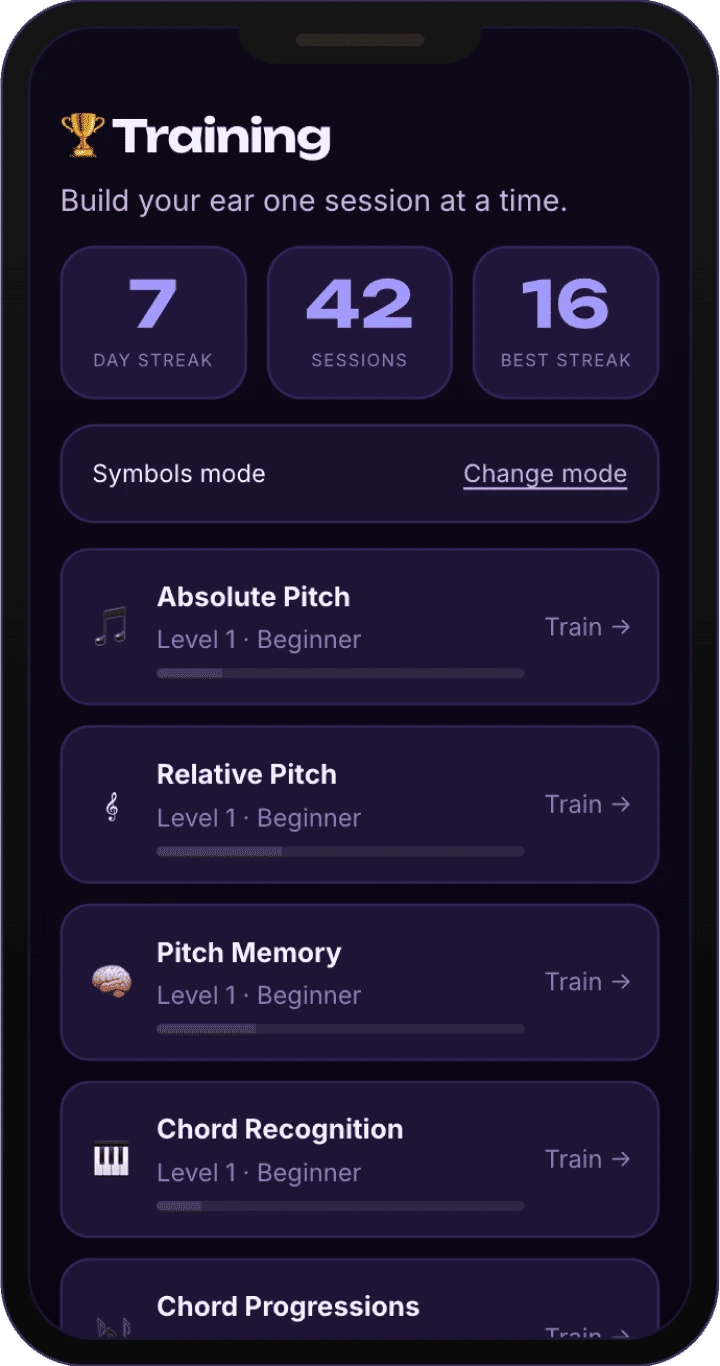
Absolute pitch. Relative pitch. Pitch memory. Chord recognition. Every skill a serious musician needs, trained in short daily sessions built around your current level.
Most ear training apps throw you into generic drills. PitchFit starts by measuring exactly where you are, then builds a plan from that baseline. You train what you actually need, not what the app assumes.
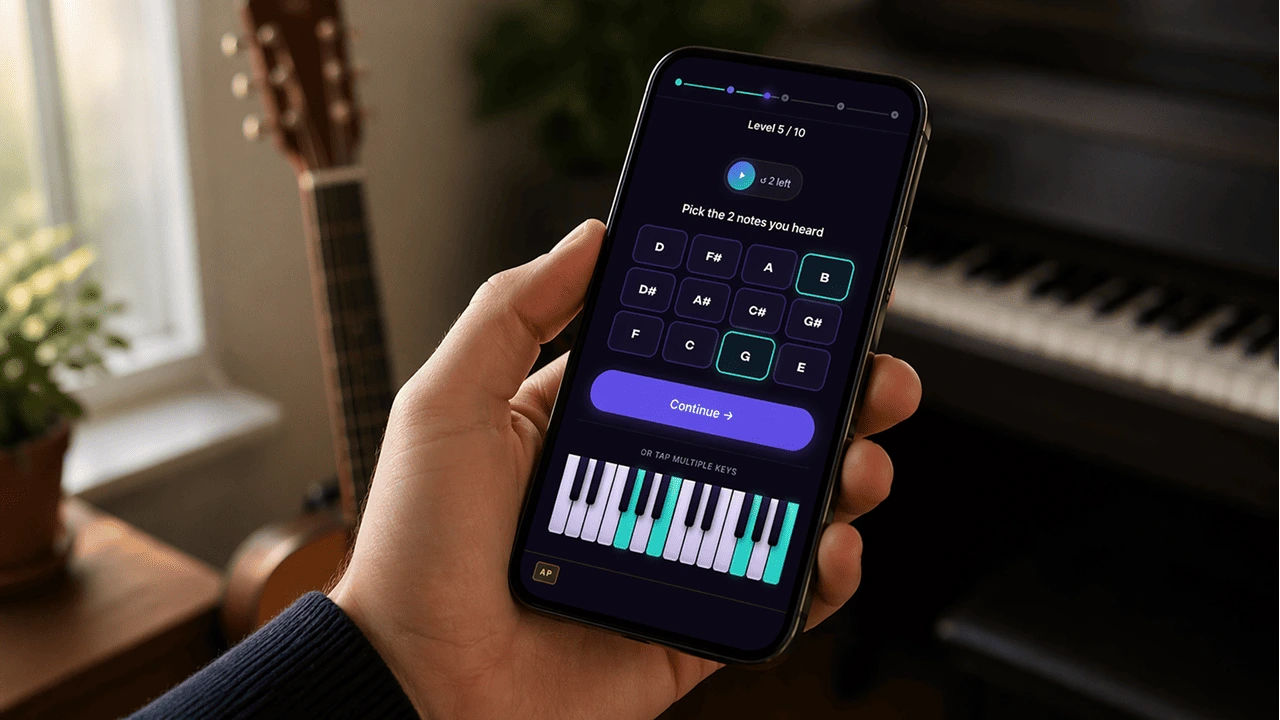
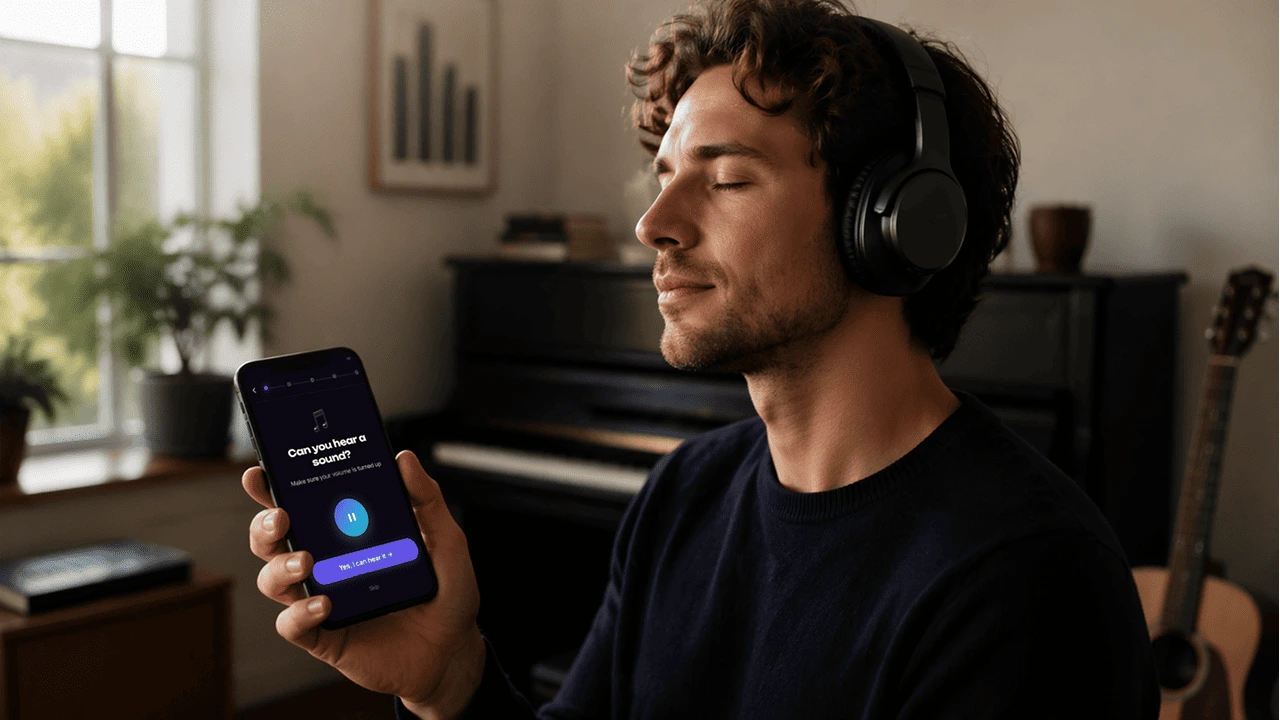
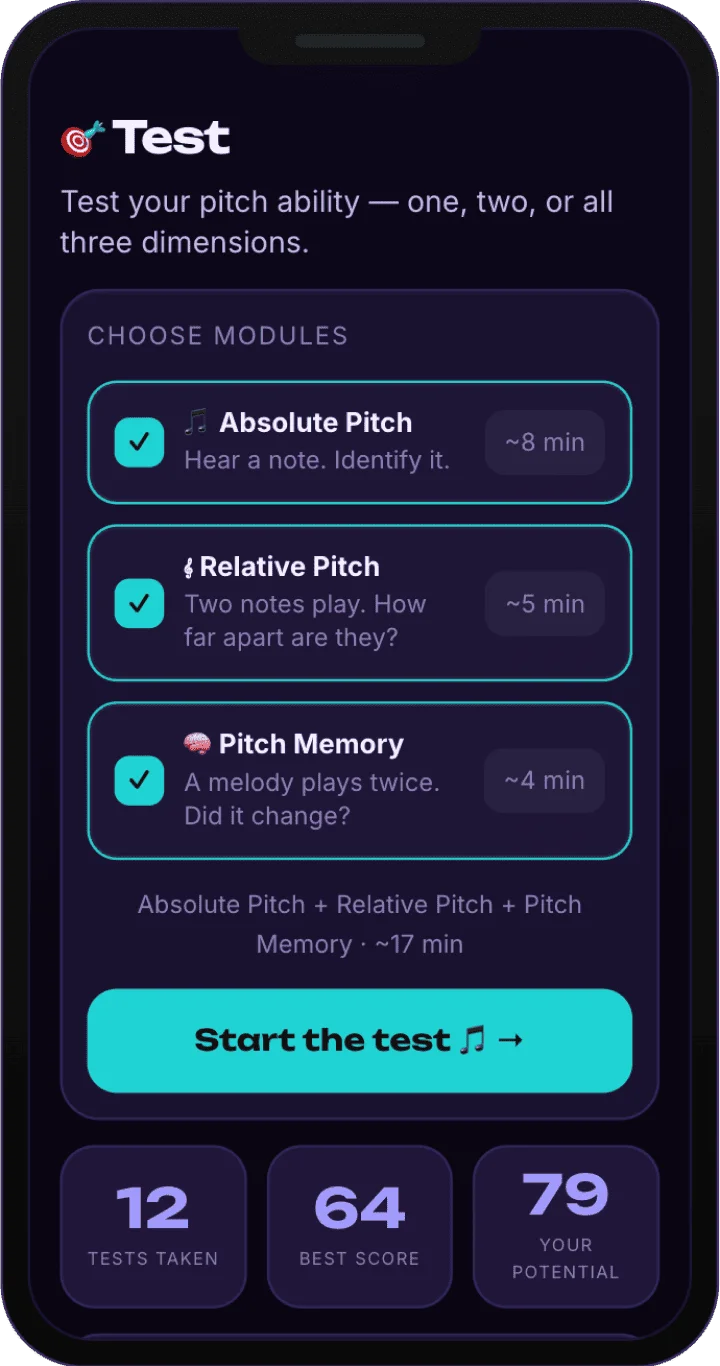
10 minutes, no music theory needed. We score your absolute pitch, relative pitch and pitch memory separately so you know exactly where you stand on each axis.
Start the test →Your results map to a personalised training plan across six disciplines. Your weakest dimension becomes your starting focus. Every exercise is pitched at your current level.
Short, adaptive sessions. Exercises get harder as your ear improves, automatically. Retake the test any time to rescore and see how far you have come.
No payment required to take the test.
A great ear is not one skill. It is a stack of related abilities, each one trained on its own adaptive track. Pick any one, or let the assessment tell you where to start.
Name any note without a reference
Train your ability to recognise and recall individual pitch classes. The rarest and most prized ear-training skill, now structured into adaptive levels anyone can progress through.
Test yourself →Hear the distance between notes
Train interval recognition, the engine behind playing by ear. When you can hear the distance between two notes, you can trace any melody, figure out any song, transcribe by ear.
Test yourself →Hold a note in your head
Train your ability to remember and compare melodic sequences. The foundation for learning songs by ear, singing in tune, and improvising over changes you cannot see coming.
Test yourself →Hear major, minor, diminished
Train your ability to identify chord types by ear. Major, minor, diminished, augmented, sevenths and beyond. This is how you figure out the harmony of any song.
Test yourself →Recognise harmonic patterns
Train your ability to recognise harmonic progressions, the patterns that power almost every song you know. I-IV-V-I, I-V-vi-IV, and every variation in between.
Test yourself →Sight-read any staff
Train your ability to identify notes on a treble clef staff. Ledger lines, accidentals, key signatures. The visual half of the pitch equation, trained with the same adaptive engine.
Learn more →Ten focused minutes a day, every day. That is enough. What matters is that the exercises meet you at your level, push you just past it, and keep a precise record of every session.
Every track has 10 levels. The engine tracks your accuracy and response time, then decides when you are ready to level up. You are never bored, never overwhelmed.
Sessions are designed to fit into your life, not the other way round. Before coffee, on the commute, between scales. Consistency beats length every time.
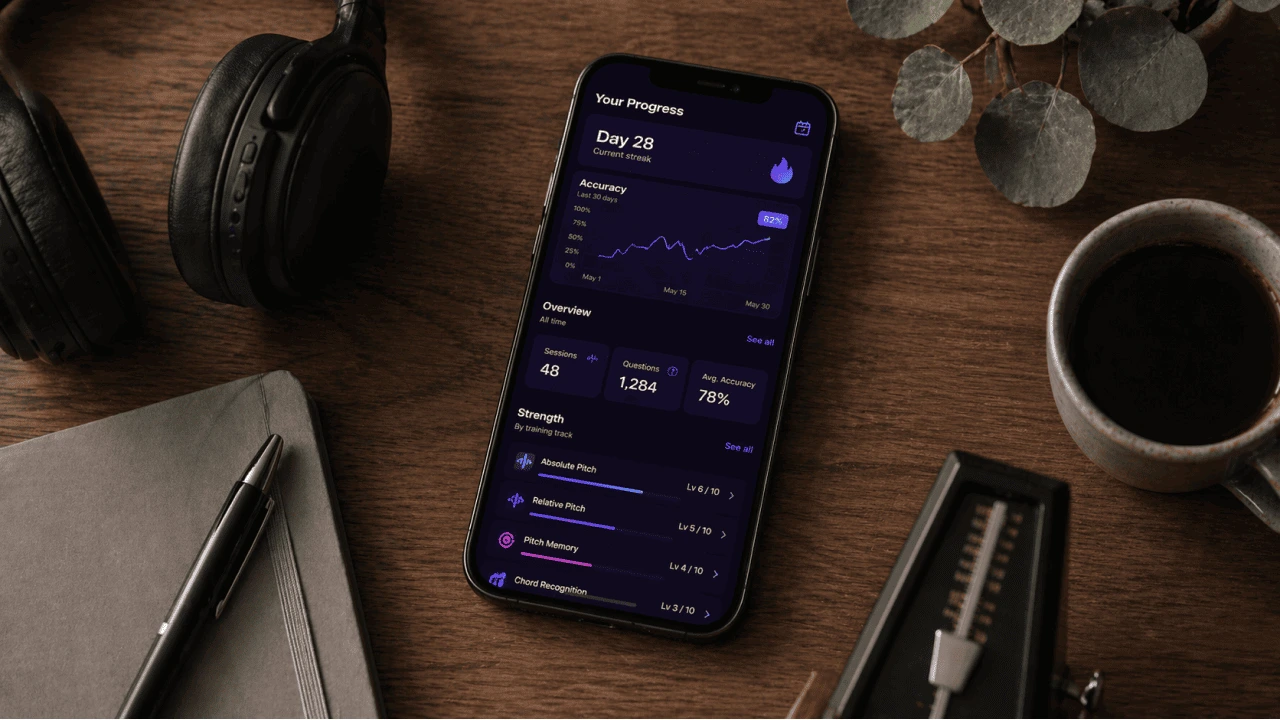
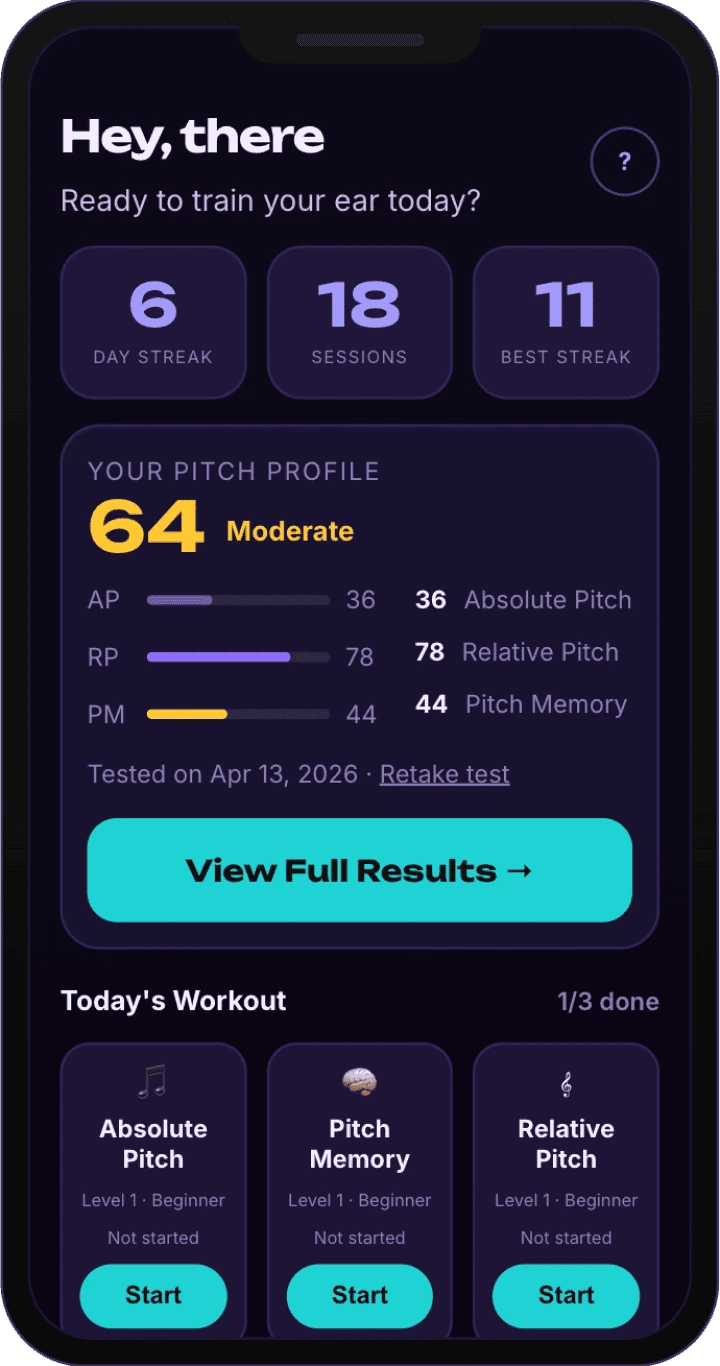
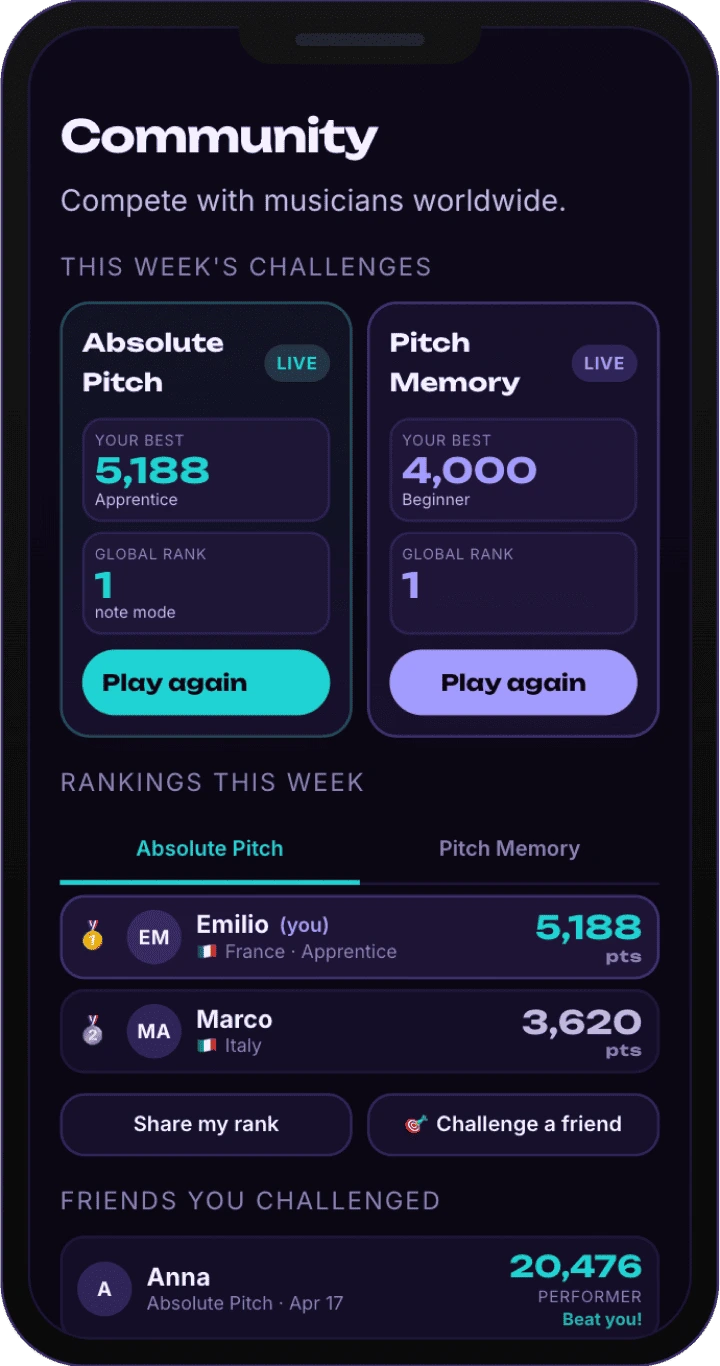
Retake the test any time to rescore your ear. Your dashboard tracks streaks, session history, score charts per track. You always know how far you have come.
Clean, focused, designed for daily use. Everything you need to train, nothing that gets in the way.
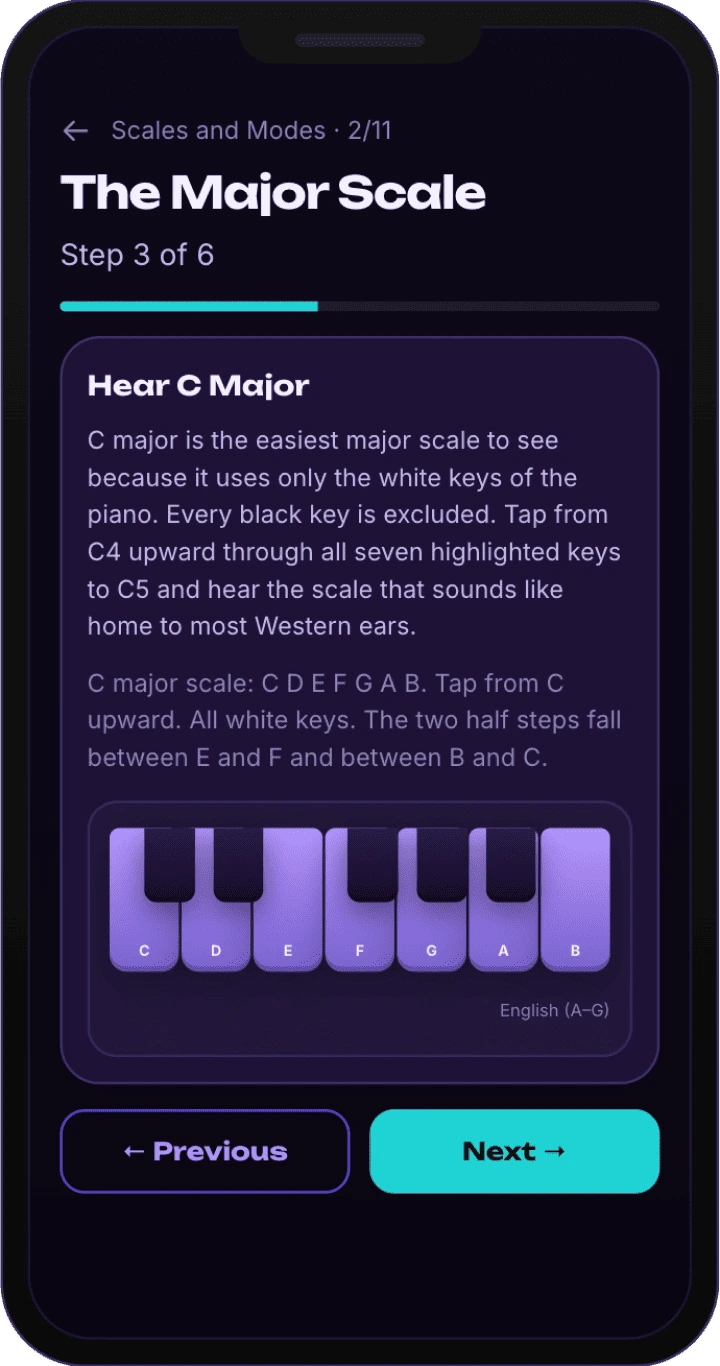
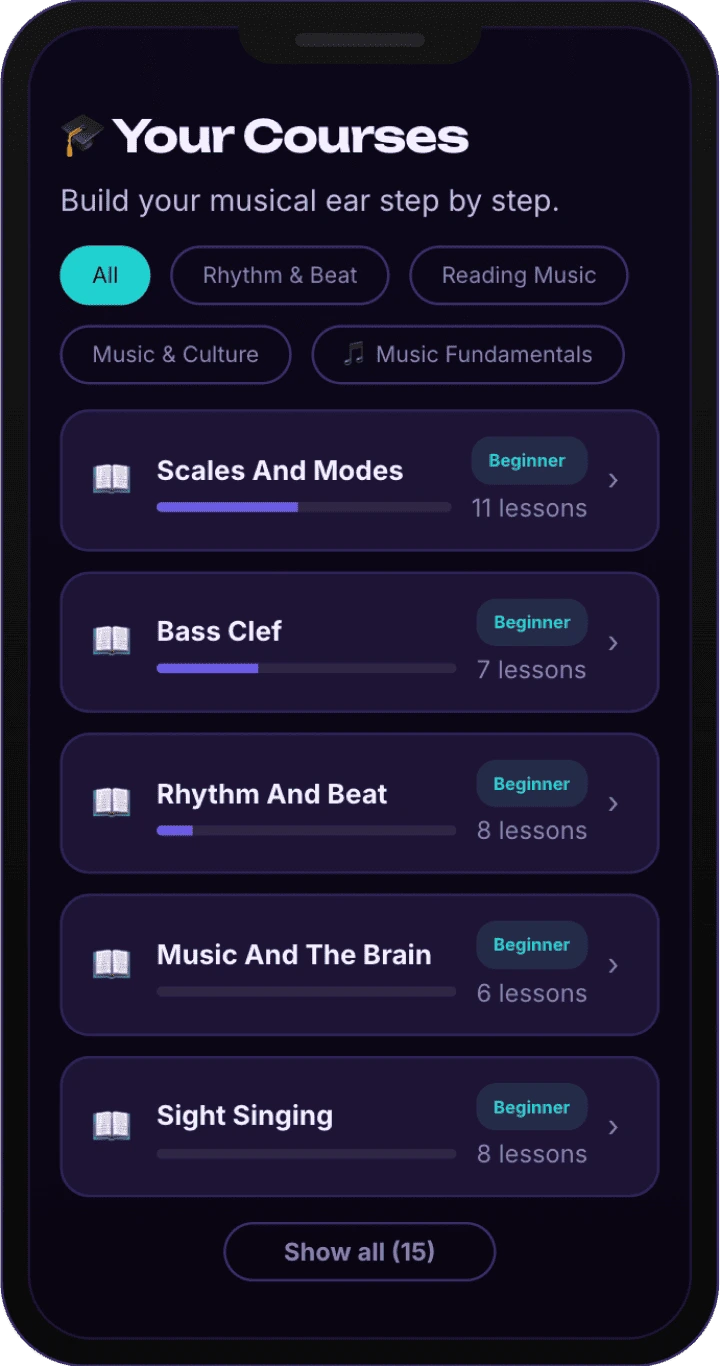
Training builds the reflex. Lessons explain what is actually happening. 18+ short structured courses across four disciplines, each ending with a quiz and a certificate.
Absolute pitch, relative pitch, melodic memory, chord recognition, chord progressions. The core theory that underpins every training track.
5 coursesBass clef, sight singing, note reading. The visual layer of pitch, taught in short lessons with quizzes that make it stick.
3 coursesRhythm, scales, modes. The grid that pitch lives on. Get your timing and tonal vocabulary working together.
2 coursesMusic and the brain, Western harmony, blues and jazz, African polyrhythm, world tuning systems. The context every musician should know.
5 coursesEvery course ends with a quiz. Pass it, earn a certificate. Training and learning work together inside one subscription.
The adult brain keeps rewiring long after childhood. Pitch perception, like any perceptual skill, responds to the same three things: frequency, feedback and progression.
Ten minutes every day beats two hours once a week. Short, daily exposure creates the spaced repetition your auditory cortex actually responds to.
Every answer is scored instantly. Your brain forms the sound-to-label connection in the same session. No guessing whether you were right.
The sweet spot is roughly 70 to 85 percent accuracy. Too easy and nothing changes. Too hard and you disengage. PitchFit calibrates to that zone automatically.
"I went from struggling with intervals to recognising them instantly. My RP score went from 14 to 71 in three months of daily sessions."
"Chord recognition was the gap in my ear. Six weeks later I can name progressions on the first pass. I am transcribing songs I could never have before."
"The assessment showed me exactly where I was weak. Pitch memory. I had no idea. Now it is my strongest track."
Ten minutes to find your baseline. A personalised plan from there.