Whether you are a French musician learning English chord charts, a German studying Italian solfège, or an Asian musician switching between jianpu and Western notation, this tool converts in real time.
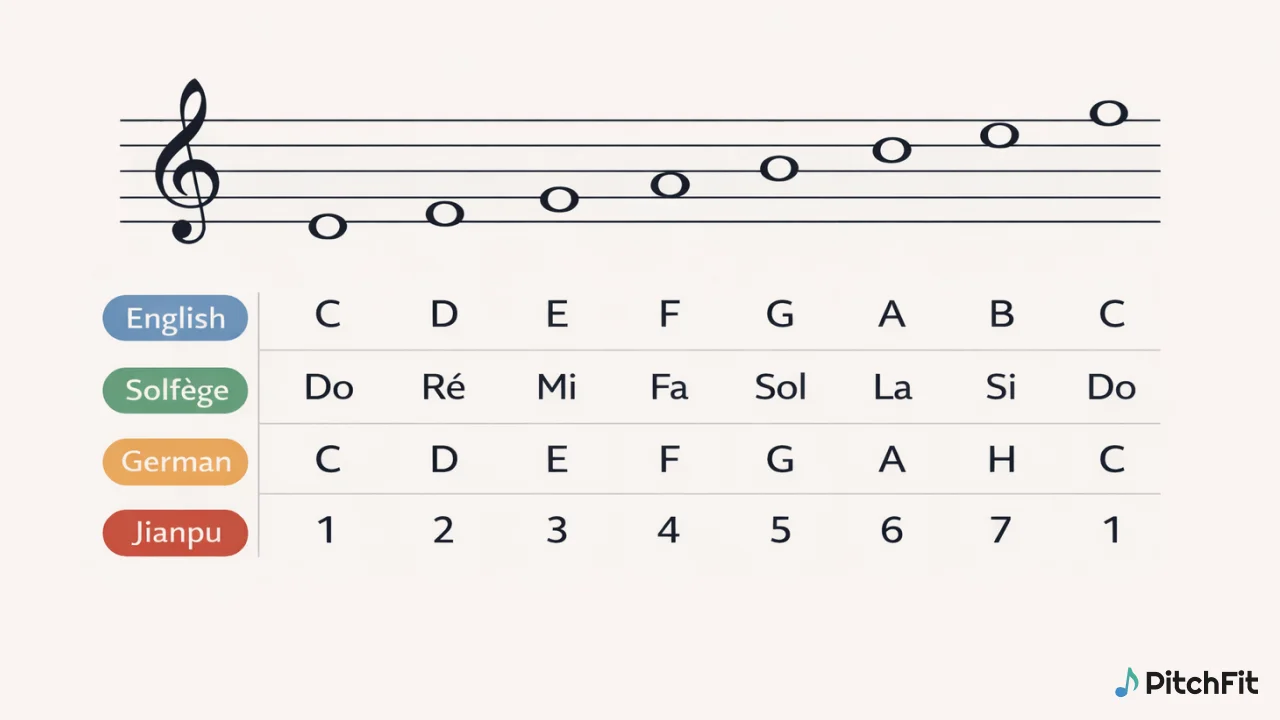
English (A B C D E F G), solfège (Do Ré Mi Fa Sol La Si), German (where B♭ = B and B = H), and Chinese jianpu (1 through 7 based on the major scale).
Sharps (♯), flats (♭), and chord qualities (m, maj7, sus4, dim, aug) are preserved. The converter only changes the root note letter and leaves the rest untouched.
No convert button to press. The output updates as you type. Use the swap arrows to flip source and target in a single click.
| English | Solfège | German | Jianpu |
|---|---|---|---|
| C | Do | C | 1 |
| D | Ré | D | 2 |
| E | Mi | E | 3 |
| F | Fa | F | 4 |
| G | Sol | G | 5 |
| A | La | A | 6 |
| B♭ | Si♭ | B | 7♭ |
| B | Si | H | 7 |
Note the German quirk on the last two rows: what the rest of the world calls B, Germans call H. And what the rest of the world calls B♭, Germans simply call B. This is historical — early notation used a square B (natural) and a round B (flat), which evolved into H and B respectively.
Medieval scribes distinguished between B rotundum (soft, rounded, lowered pitch) and B quadratum (hard, square, natural pitch). The square b eventually resembled an h and became H in German-speaking regions, while B came to mean B-flat. This convention is still used throughout Germany, Austria, Czech Republic, Poland, and much of central Europe.
Jianpu (简谱) is a numerical notation system popular in China. Numbers 1 through 7 represent the degrees of the major scale: 1 is the tonic (Do / C in the key of C), 2 is the second degree (Ré / D), and so on. It is movable — 1 always refers to the tonic of the current key, similar to solfège in some traditions.
Yes. The converter identifies the root note of each chord symbol (including sharps and flats) and translates only the root. The quality suffix (m, maj7, sus4, etc.) stays as-is, since it is used identically across notation systems.
This converter uses fixed-do solfège, the system used in France, Italy, Spain, and most of Latin America. In fixed-do, Do always means C, Ré always means D, and so on — regardless of the key. This is different from movable-do, where Do refers to the tonic of whatever key you are in.
Train your ear to recognise the notes, not just name them.