🎸
Guitar Tuner
by PitchFit
🎙️
Allow microphone access
We need to hear your guitar to detect the pitch. Audio is processed locally in your browser — nothing is recorded or sent anywhere.
Microphone access was denied. Enable it in your browser settings and reload the page.
Listening…
−50¢ −25¢ 0 +25¢ +50¢
Reference A
440 Hz
Free online guitar tuner

Tune your guitar in seconds

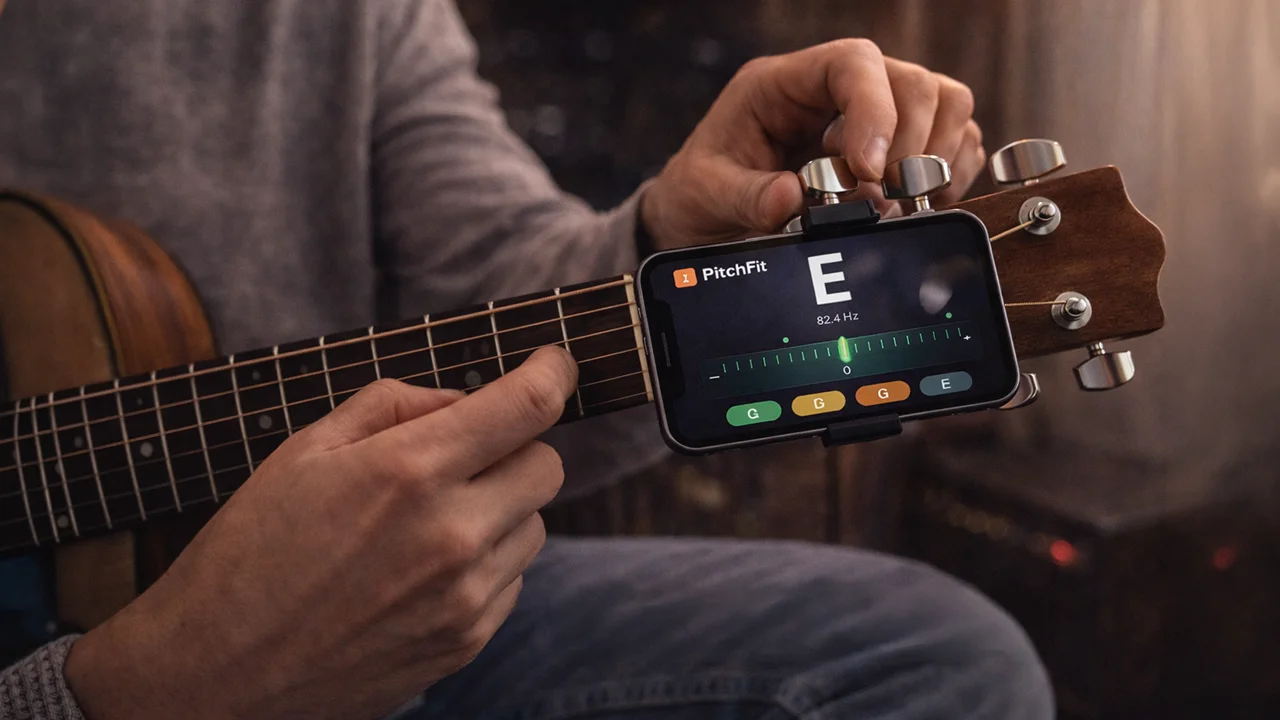
A precise chromatic tuner that listens through your microphone and guides you to standard EADGBE tuning. Works for acoustic, electric, classical, and 12-string guitars.

🎯

Chromatic detection

The tuner detects any note — not just the six open strings — so it works for alternate tunings, drop tunings, and capoed positions.

Accurate to ±2 cents

Uses the YIN pitch-detection algorithm for sub-cent precision in a quiet room. That is finer than what most guitar ears can distinguish.

🔒

Private and local

All audio processing happens in your browser. Nothing is recorded, nothing is uploaded, nothing leaves your device.

How to tune

Standard tuning, string by string

Standard guitar tuning from thickest to thinnest string is E, A, D, G, B, E. Pluck each open string and adjust the tuning peg until the needle centres on green.

6th string (thickest) — E2 (~82.4 Hz)

The lowest E string. Turn the tuning peg counterclockwise (facing the headstock) to tighten.

5th string — A2 (~110 Hz)

A perfect fourth above the 6th string.

4th string — D3 (~146.8 Hz)

Another perfect fourth up.

3rd string — G3 (~196 Hz)

A perfect fourth above D.

2nd string — B3 (~246.9 Hz)

A major third up from G — the one interval that breaks the perfect-fourth pattern.

1st string (thinnest) — E4 (~329.6 Hz)

Two octaves above the 6th string. The highest pitch in standard tuning.

Common questions

FAQ

Why does the tuner jump between octaves?

Low notes have strong harmonics that can confuse pitch detection, especially on acoustic guitars with resonant bodies. If the tuner reads an octave higher than expected, pluck the string more softly and mute the other strings.

Can I use this with an electric guitar?

Yes. If your computer has a microphone, it will pick up the acoustic sound of the strings even on an electric guitar. For maximum accuracy, plug your guitar into your computer via an audio interface and the browser will use that input.

Does it work for alternate tunings like Drop D or DADGAD?

Yes — the chromatic detection works for any tuning. The tuner will still light up the closest E pill, but ignore the pill highlighting and focus on the cents reading. It should hit 0 cents on each target note for your alternate tuning.

Why does my guitar keep going out of tune?

New strings stretch — plan to retune several times in the first week. Beyond that, temperature and humidity changes affect wood and string tension. Always tune up to pitch (not down) to let the string hold its tension, and stretch new strings by gently pulling them after installation.

What is the A = 440 Hz setting for?

A4 is the tuning reference for the entire musical system. The modern standard is 440 Hz, but some musicians use 432 Hz (a theory with no scientific basis but some cultural following) or 442 Hz (common in some European orchestras). Change it if your band or ensemble uses a different reference.

More tools

Other free tools for guitarists

Tune your guitar, train your ear

The best guitarists can tune by ear. We teach you how.

Take the free pitch test →