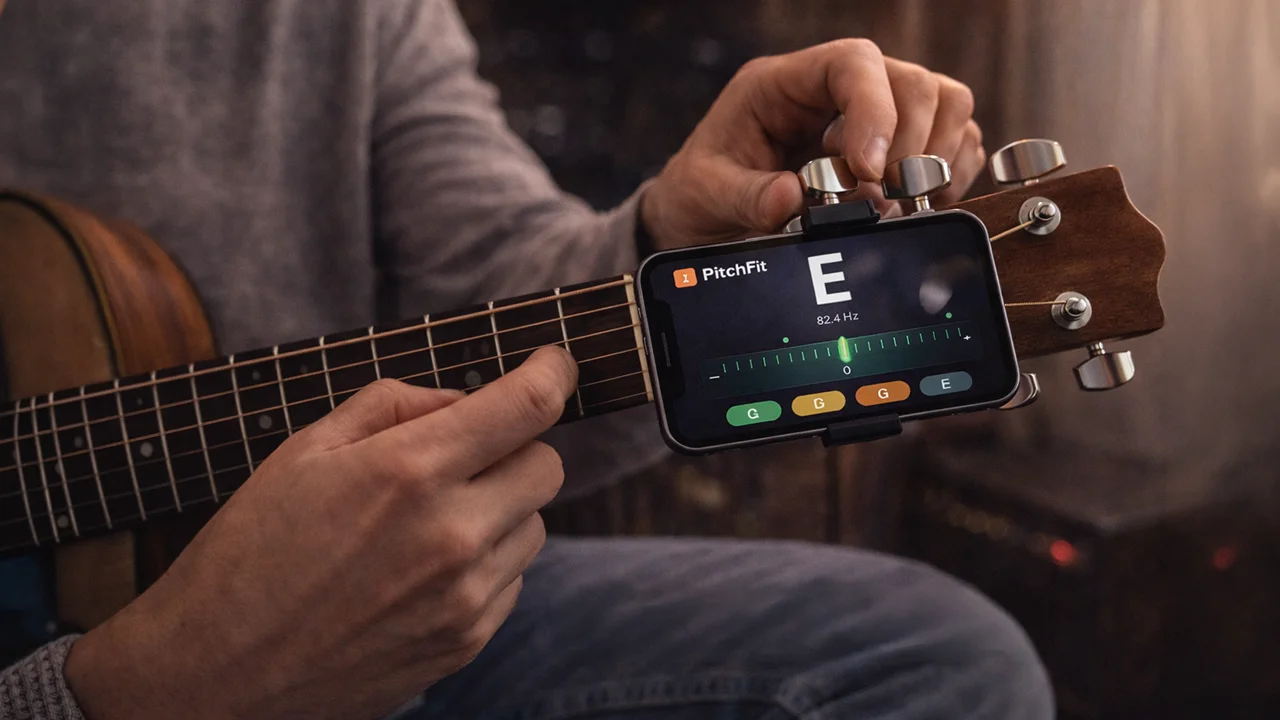
Wir müssen deine Gitarre hören, um die Tonhöhe zu erkennen. Audio wird lokal in deinem Browser verarbeitet — nichts wird aufgezeichnet oder irgendwohin gesendet.
Mikrofonzugriff wurde verweigert. Aktiviere ihn in den Browsereinstellungen und lade die Seite neu.
—
Hört zu…
−50¢−25¢0+25¢+50¢
Referenz A
440 Hz
Kostenloser Online‑Gitarren‑Tuner
Stimme deine Gitarre in Sekundenschnelle
Ein präzises chromatisches Stimmgerät, das über dein Mikrofon hört und dich zur Standardstimmung EADGBE führt. Funktioniert für Akustik‑, E‑, klassische und 12‑saitige Gitarren.
Chromatische Erkennung
Der Tuner erkennt jede Note — nicht nur die sechs offenen Saiten — und funktioniert daher für alternative Stimmungen, Drop‑Stimmungen und mit Capo gesetzte Positionen.
Genauigkeit ±2 Cent
Verwendet den YIN‑Pitch‑Erkennungsalgorithmus für Sub‑Cent‑Genauigkeit in ruhiger Umgebung. Das ist feiner, als die meisten Gitarrenohren unterscheiden können.
Privat und lokal
Die gesamte Audioverarbeitung erfolgt in deinem Browser. Nichts wird aufgezeichnet, nichts hochgeladen, nichts verlässt dein Gerät.
So stimmst du
Standardstimmung, Saite für Saite
Die Standardstimmung der Gitarre von der dicksten bis zur dünnsten Saite ist E, A, D, G, B, E. Zupfe jede offene Saite und drehe die Stimmmechanik, bis die Nadel in der Mitte auf Grün steht.
E2
6th string (thickest)~82.4 Hz
Die tiefste E‑Saite. Drehe die Stimmmechanik gegen den Uhrzeigersinn (mit Blick auf die Kopfplatte), um zu spannen.
A2
5th string~110 Hz
Eine reine Quarte über der 6. Saite.
D3
4th string~146.8 Hz
Eine weitere reine Quarte nach oben.
G3
3rd string~196 Hz
Eine reine Quarte über D.
B3
2nd string~246.9 Hz
Eine große Terz über G — das einzige Intervall, das das perfekte‑Quart‑Muster unterbricht.
E4
1st string (thinnest)~329.6 Hz
Zwei Oktaven über der 6. Saite. Die höchste Tonhöhe in der Standardstimmung.
Häufige Fragen
FAQ
Tiefe Töne haben starke Obertöne, die die Tonhöherkennung verwirren können, besonders bei akustischen Gitarren mit resonantem Korpus. Wenn der Tuner eine Oktave höher anzeigt als erwartet, zupfe die Saite etwas sanfter und dämpfe die anderen Saiten.
Ja. Wenn dein Computer ein Mikrofon hat, nimmt es den akustischen Klang der Saiten auch bei einer E‑Gitarre auf. Für maximale Genauigkeit schließe deine Gitarre über ein Audio‑Interface an den Computer an — der Browser verwendet dann dieses Eingangssignal.
Ja — die chromatische Erkennung funktioniert für jede Stimmung. Der Tuner wird weiterhin das nächstgelegene E‑Feld hervorheben, ignoriere aber die Hervorhebung und achte auf die Cent‑Anzeige. Für deine alternative Stimmung sollte die Anzeige bei den Zielnoten 0 Cent erreichen.
Neue Saiten dehnen sich — plane, in der ersten Woche mehrmals nachzustimmen. Darüber hinaus beeinflussen Temperatur‑ und Feuchtigkeitsänderungen Holz und Saitenspannung. Stimme immer nach oben zur Zieltonhöhe (nicht nach unten), damit die Saite ihre Spannung behält, und dehne neue Saiten, indem du sie nach dem Aufziehen vorsichtig ziehst.
A4 ist die Stimmreferenz für das gesamte Tonsystem. Der moderne Standard ist 440 Hz, aber einige Musiker verwenden 432 Hz (eine Theorie ohne wissenschaftliche Grundlage, aber mit gewisser kultureller Anhängerschaft) oder 442 Hz (in einigen europäischen Orchestern üblich). Ändere es, wenn deine Band oder dein Ensemble eine andere Referenz verwendet.